Mobbler Spotlight: Kangaroo Island Eggs
We’re always impressed to see Mobblers all over the world doing some pretty interesting things. We’re lucky to hear a lot of great stories, and from time to time we like to share a few.
Thomas Fryar is one of those farmers. He uses Mobble to manage his 2,000 sheep, while running a booming egg business which is well worth a closer look.
Tom Fryar Senior grew up on Kangaroo Island where his own parents were part of the soldier settlement scheme. Early in life, Tom worked as a shearer before he and his wife Fiona married and bought a modest 100-acre farm.
Their son Thomas describes them as “schemers” - full of ideas through the late ’80s and early ’90s. They tried their hand at everything including building a large glasshouse to grow tomatoes, before experimenting with ducks. But it was chooks that stuck.
From the outset, Tom and Fiona questioned what “free range” really meant. Their view was simple: most people weren’t getting what they thought they were paying for. So they did things differently, pioneering a pasture-raised system with small flocks housed in mobile sheds, giving birds constant access to fresh pasture. Today, mobile chicken caravans are widely adopted - but back then, they were well ahead of their time.
Thomas and his brother Jason grew up in the thick of it, spending their childhood collecting and packing eggs - “slave labour,” he jokes. As demand grew, so did the business. What started small began to snowball, eventually employing staff and expanding beyond the original farm.
.jpg)
Over the past decade, Tom and Fiona have stepped back, handing the reins to Thomas and Jason, alongside their wives Kirby and Bonnie.
From an initial 400 chooks on 100 acres, the operation has grown into something much larger. Today, the family manages 5,500 acres and runs around 80,000 birds. Growth has come steadily, through the acquisition of neighbouring blocks - 500 acres here, 1,000 there - all adjoining pasture.
“A big credit goes to my parents who got this off the ground. I always knew I wanted to get into the family farm,” Thomas explains.
After spending time in Adelaide in his early twenties, Thomas returned home for good. “I’ve been back here full time with my brother, and that’s when we decided to knuckle down and take the business to the next level.”
They now run around 80 mobile chicken sheds, all built on-site, each housing about 1,000 birds. Egg collection alone is a major operation. The business employs 32 staff - significant on an island of just 5,000 people - with teams working split rosters, collecting eggs seven days a week.
All grading and processing happens on-farm, with eggs checked for cracks and sorted by size before packing.
Kangaroo Island Eggs has built its model around controlling the entire supply chain, from paddock to plate. Each week, two semi-trailers of eggs leave the island. A smaller truck delivers 6–8 pallets daily into the Adelaide market, while around a quarter of production is transported to Sydney and Melbourne via third-party logistics.
Since taking over, the Fryar brothers have focused heavily on efficiency.
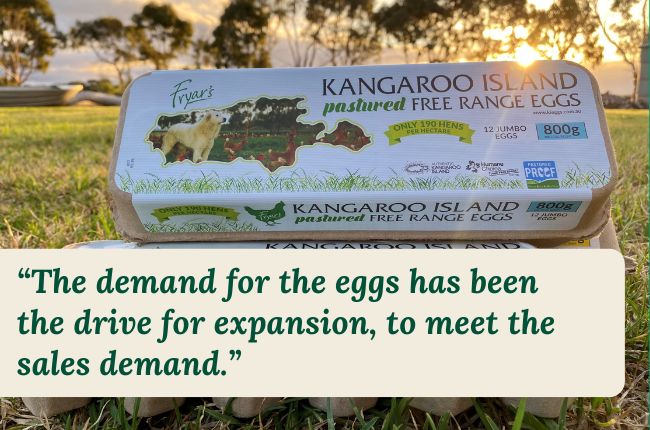
“The demand for the eggs has been the drive for expansion, to meet the sales demand. We’ve worked hard to improve the grading facility, we’ve grown our workforce and poultry numbers. When the company gets bigger you can’t just run it off the top of your head. We’ve systemised the programs to keep on top of it.”
Alongside the poultry operation, the business also runs sheep and cropping enterprises.
“With our cropping program we’re using Agworld - and through that we dabbled with livestock programs, which is how we came across Mobble. We found it the easiest to use, and the best for what we do. Mobble and Agworld are integrated, so we can have our sheep data on the same page as cropping data”.
They produce grain that feeds directly into the chicken operation via their on-site feed mill.
“In order to have chooks, we need grain,” Thomas explains. “We crop about 3,000 acres, harvest that, and with our feed mill create the feed for the chooks.”
They also run 2,000 breeding ewes, with lambs finished on the crop stubbles. “We’re about to sell most of our lambs next week, and then we’ll be ready to plant a crop again.”
The system is tightly integrated: chicken manure is returned to the paddocks as fertiliser, feeding the soil and the crops.
A good egg, Thomas says, should have a deep coloured yoke. The yolk and white should be plump, and not spread much when cracked into a pan. The flavour is determined by how the birds are raised and treated.
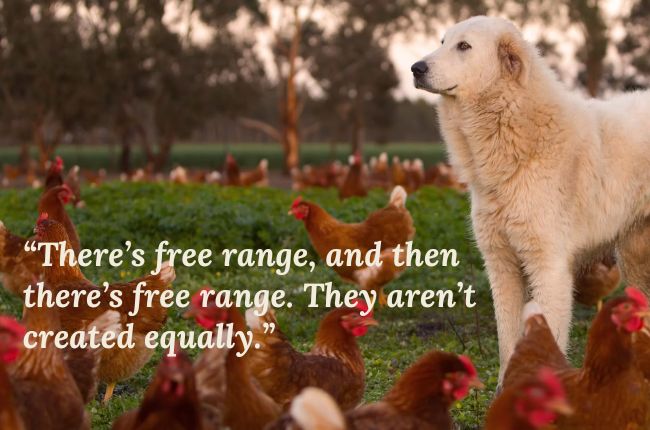
“Our chooks get natural sunlight constantly, they eat insects, they’re grain fed, and have constant access to pasture”.
“There’s free range, and then there’s free range. They aren’t created equally.” For Thomas, the best way to eat a good egg is simple - poached. “Straight into a bit of water - when you’ve got a nice, fresh egg, you don’t need vinegar”.
Continually building on the legacy created by Tom and Fiona, Kangaroo Island Eggs are Australia’s largest producers of pasture-raised free range eggs. Between Thomas, Jason, Kirby and Bonnie, they’ve got seven kids. Thomas explains that his hope is that they go off the island and experience something different, but that they’ll then be drawn back into the family business. Each afternoon they jump off the school bus and get straight into egg grading, so the signs are looking good.
Follow Kangaroo Island Eggs here.